Comparisons
Website Builder vs. Web Design Agency: Which Fits Your Business?
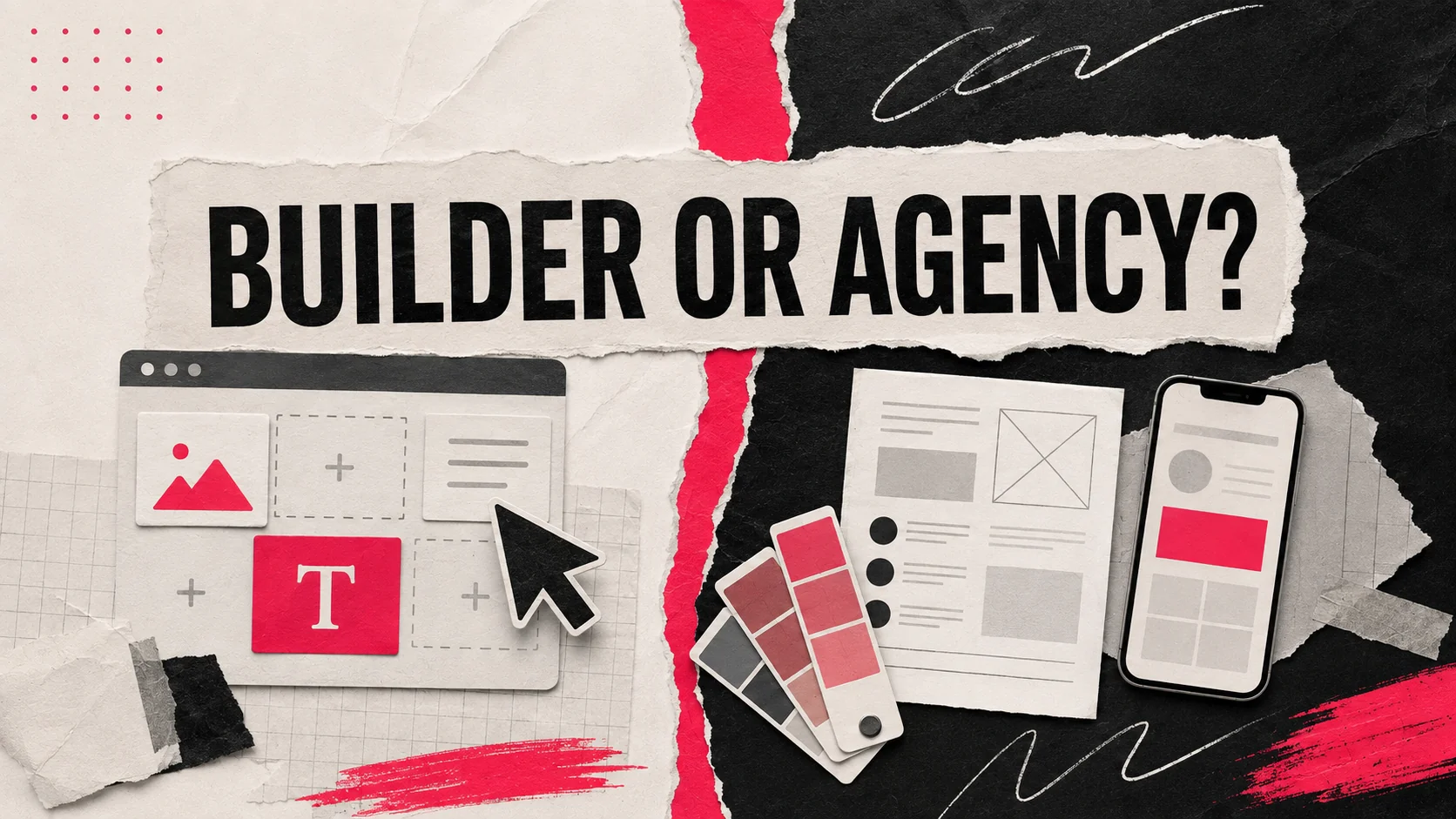
A website builder trades your time for money; an agency trades your money for time. Which one fits depends on how simple the site is, how much of your own time is genuinely available, and how much the website matters to how you get work. For plenty of small businesses, a builder is the right answer.
What You Get With a Website Builder
A platform that hosts the site, an editor you drag things around in, a library of designs, and the entire job of filling it in.
Builders are genuinely good at what they do. You can have something live in a weekend without talking to anyone, without a brief and without a deposit. The hosting, the security certificate, the editor and the design come as one subscription, and none of it requires you to understand any of it.
The work you take on is the design decisions, the copywriting, the photography, the structure and the maintenance. That is not a small list, but it is a list many owners can work through, and doing it yourself means you understand your own site well enough to change it at ten at night.
What is genuinely good about it
It is worth being specific, because the honest case for builders is stronger than agencies usually admit.
- Live quickly, with no dependency on anyone's availability
- Low, predictable monthly cost with nothing unexpected
- You can change anything yourself, immediately
- Hosting, certificates and updates are somebody else's problem
- Designs that are competent out of the box
What you are accepting
The constraints are structural rather than cosmetic, which is why they only show up later.
- The design is one other businesses also use
- You are doing the writing, and writing is the hard part
- The subscription continues for as long as the site exists
- Moving to another platform generally means rebuilding
- Editors get slow and heavy on complicated pages
What You Get With a Web Design Agency
A finished site built to a scope, with the structure, design and usually the copy done for you, and someone accountable for the outcome.
The thing you are actually buying is not the design. It is the decisions: what the pages should be, what each one has to say, what to lead with and what to leave out. Those decisions are the difference between a site that reads well and one that is merely tidy, and they are the part that is hardest to do for your own business.
You are also buying a finish date. A builder project finishes when you finish it, and a meaningful share of them never do. An agency project has a scope, a schedule and someone whose job it is to deliver against it.
What is genuinely good about it
The value concentrates in the parts an owner cannot easily do alone.
- The structure is designed around how your business actually sells
- Copywriting is usually included, which removes the real blocker
- It gets finished, on an agreed timeline
- The design belongs to your business rather than to a template library
- Someone is accountable when something is wrong
What you are accepting
The trade is real and worth naming plainly.
- Higher cost up front
- You still have to supply the raw material: services, photos, facts
- Changes after launch usually mean asking someone
- Quality and process vary enormously between providers
- A bad fit is more expensive than a bad builder subscription
Agency covers a very wide range, from one person working under a business name to a studio with a team. The word tells you almost nothing on its own; the scope document tells you everything.
Compare Cost, Time, Flexibility and Support
The two routes differ on eight factors that actually change the outcome. None of them makes one route correct.
We have deliberately left money off this table. The cost comparison depends on your scope, on which builder, on which agency and on how you value your own hours, and a price column here would be a guess presented as a fact. What a website costs and how to compare quotes is covered in its own guide.
| Factor | Website builder | Web design agency |
|---|---|---|
| Your time | Substantial, and it is your evenings | A briefing and a few rounds of review |
| Time to finished | Whenever you finish it | An agreed date |
| Design | Chosen from a library | Made for the business |
| Copywriting | Yours to write | Usually included |
| Structure | What the template assumes | What your business needs |
| Changing it later | Immediate, by you | Usually a request to someone |
| Technical upkeep | Handled by the platform | Depends on the agreement |
| If something breaks | Platform support, generic | A person who knows your site |
| Learning curve | Real, and it is yours | Almost none |
Ownership and Ongoing Responsibilities
This is where the two routes differ most and where the difference is least visible at the point of choosing.
On a builder, the platform is the site. The design, the editor, the hosting and the content management are one product, and the subscription is what keeps the thing online. That is a fair trade for what you get, but it means the site is rented rather than owned, and leaving is a rebuild rather than a move.
With an agency, ownership depends entirely on the agreement, and the range is wide. Some build on infrastructure you control and hand you everything. Others keep the site on their own hosting behind a monthly fee, which is functionally the same arrangement as a builder with a person attached. Neither is dishonest, but they are very different purchases and the difference is often not stated.
Ask before you commit, either route
Three questions settle it, and they should get quick, unambiguous answers.
- Is the domain registered in my name?
- Is the hosting account in my name, and do I have the credentials?
- If I stop paying, what happens to the site?
The one rule that always applies
Register the domain yourself, in your own name, whatever else you decide. It costs very little, it takes ten minutes, and it is what makes every later decision reversible. A site can be rebuilt; a domain someone else controls is a negotiation.
Which Option Fits Your Business
A builder fits when the site is simple, the time exists and the stakes are low. An agency fits when the site has to be right, has to be finished, or has to be shaped around how you actually sell.
The failure mode of the builder route is not a bad website. It is an unfinished one: bought in January, still showing demo text in June, quietly charging a subscription. If you know that is the likely outcome, the cheap option was never cheap.
The failure mode of the agency route is paying for judgement you did not need. If your business is three services in one town and you have a weekend free, you may not need anyone's structural thinking, and there is no reason to pretend otherwise.
A builder is probably the right call if
These are the conditions where doing it yourself is genuinely the better decision, not a compromise.
- The site is a handful of straightforward pages
- You have real time and you will actually use it
- You enjoy this kind of thing, or at least do not dread it
- Most of your work comes from referrals and the site is a credibility check
- You are testing whether a website produces anything before investing
- Money is tight right now and something live beats nothing
Hiring someone is probably the right call if
The common thread is that the structure is doing real work.
- The site is a main source of new customers
- The structure is complicated: several service lines, or two audiences
- You have started a builder site before and not finished it
- Writing the copy is the thing that has stalled you
- You need it live by a date that matters
- Your competitors' sites are better and it is costing you
There is also a middle path people forget: hire someone for the structure and the copy, then take over the day-to-day yourself. That works when ownership is set up properly from the start.
Questions to Ask Before You Decide
Answer these honestly and the choice usually makes itself. The one people get wrong is the second.
- What is the site actually for: enquiries, credibility, or both?
- How many hours can I genuinely give this, in the next month, not in theory?
- Who is writing the words, and when?
- Do I have usable photographs of my own work?
- How many services need their own page?
- Does this need to be live by a particular date?
- What happens to my business if the site is mediocre for a year?
- Am I comfortable being the person who fixes it when it breaks?
- Who will own the domain and the hosting?
- If I choose wrong, how expensive is it to change course?
The second question is where most of these decisions actually turn, and it is the one people answer optimistically. Answer it with the last three months as evidence rather than with next month's intentions.
Frequently asked questions
Is a website builder good enough for a small business?
For many small businesses, yes. If the site is a handful of straightforward pages, you have real time to spend on it and most of your work comes from referrals, a builder is a reasonable answer rather than a compromise.
It stops being enough when the structure is doing real work, when the site is a main source of customers, or when writing the copy is the thing that has stalled you.
What does a web design agency actually do that I cannot?
Mostly it makes the decisions: what the pages should be, what each one has to say, what to lead with and what to leave out.
Those are the hardest judgments to make about your own business, and they are the difference between a site that reads well and one that is merely tidy.
Is an agency website better for SEO than a builder?
Not automatically. Both can be built well and both can be built badly.
What matters is the structure, the page titles, the headings, the speed and whether the content answers what people search for. A builder can do all of that; it just will not do it unless you do.
Can I start with a builder and move to an agency later?
Yes, and it is a sensible sequence if money is tight now.
The one thing that makes it easy rather than painful is registering the domain in your own name from the start. The site can be rebuilt; a domain somebody else controls is a negotiation.
Leaning toward having it built?
We do fixed-scope website projects for small businesses: up to seven pages, copy drafted from your briefing, deployed to hosting you own with no monthly fee to us.