
Being found for the business name
Necessary, and close to worthless on its own. These are people who already know you exist and were going to reach you anyway.
Websites, SEO and ads for small businesses$1,497 for a professional websiteYou own your domain and hostingNo monthly fees to us
SEO
Most small business SEO fails for an ordinary reason: the site answers a question nobody typed. We start from the searches your customers really make, then make the site the best available answer to them.
Scoped per business and quoted on its own. It is not a package, and it is not sold by the hour.
A website only works on people who reach it. SEO is the part of the job that decides how many of those there are and, more importantly, who they are.
Search is where most local buying decisions start, and it is unusual among channels in that the person has already told you what they want. Somebody typing a service and a town is further along than anyone an advertisement interrupted, which is why a small share of search traffic can be worth more than a large share of anything else.
The part that gets missed is that visibility is not one thing. Ranking for the name of your business is table stakes and produces almost nothing new. Ranking for what you sell, where you sell it, is the work, and it is a different job with a different answer.
Necessary, and close to worthless on its own. These are people who already know you exist and were going to reach you anyway.
Somebody who needs what you do and has not decided who does it. This is the traffic worth working for, and the hardest to get.
A search from twenty miles outside your area is not an opportunity. Relevance to where you actually work matters as much as relevance to what you do.
You cannot optimise a site into answering a question it does not contain. Most of what people call SEO work is really structure and content work that happens to be measured in search.
If your services live on one combined page, no amount of technical work will make that page rank for three different searches. If the page loads slowly on a phone, the ranking you win converts worse than the one you did not. If nothing on the site says which towns you cover, the searches that include a town cannot match you.
This is why we treat the two as one job rather than two invoices. On a site we build, the technical fundamentals are in from the start: page titles, heading structure, a sitemap, clean URLs, sensible internal linking. On a site we did not build, the first thing we do is find out which of those are missing.
If you are still deciding whether to rebuild or optimise what you have, say so. The answer is genuinely sometimes the second one.
Not sure whether the site or the search is the problem?
Tell us the site and what you sell. We will say which of the two we would work on first, and why.
Six areas, in roughly the order they matter. Which of them a project needs depends entirely on what is already there.
Nothing below is a monthly quota of blog posts or links. Those are the two things most commonly sold as SEO and the two most commonly disconnected from whether a business gets found for what it sells.
Crawlability, indexing, page titles and descriptions, heading structure, sitemap, canonical URLs, redirects, and how fast the site loads on a phone.
How pages are grouped and linked. Which services deserve their own page, which do not, and how somebody moves between them.
The pages that have to rank and convert at the same time. One clear intent each, written to answer the search rather than to contain the phrase.
The questions your customers ask before they contact anyone, answered properly. Written from the work rather than from a keyword list.
Making the relationship between your pages obvious to a reader and legible to a search engine, which are usually the same fix.
Where it applies: service area stated as text, consistent business details, and pages that make sense for the places you actually work in.
We do not sell link building and we do not buy links. If a proposal from anyone leans on that, ask what happens when the links are devalued.
The same person searches differently at each stage, and a page that answers the wrong stage loses them even when it ranks.
Somebody who has just realised they have a problem searches in symptoms. Later they search in solutions. Later still they search in providers, and finally in names and prices. Four searches, four different pages, one customer.
A site built only for the last stage is invisible until the decision is nearly made. A site built only for the first collects readers who never buy. The work is deciding which stages are worth owning for your business, and what each page has to do when somebody lands on it.
Searching the symptom, not the service. Usually answered by a guide rather than a service page.
Searching what fixes it. This is where a well-written service page starts to earn its place.
Searching the service plus a place. Relevance, proof of the work and an easy way to make contact decide this one.
Comparing two or three specific businesses. What the site says about scope, process and price does the work here.
Sixteen concepts from the studio, built from the same five directions. Search work ends at a page, and these are the kind of page it should end at: one clear intent, one obvious next action.







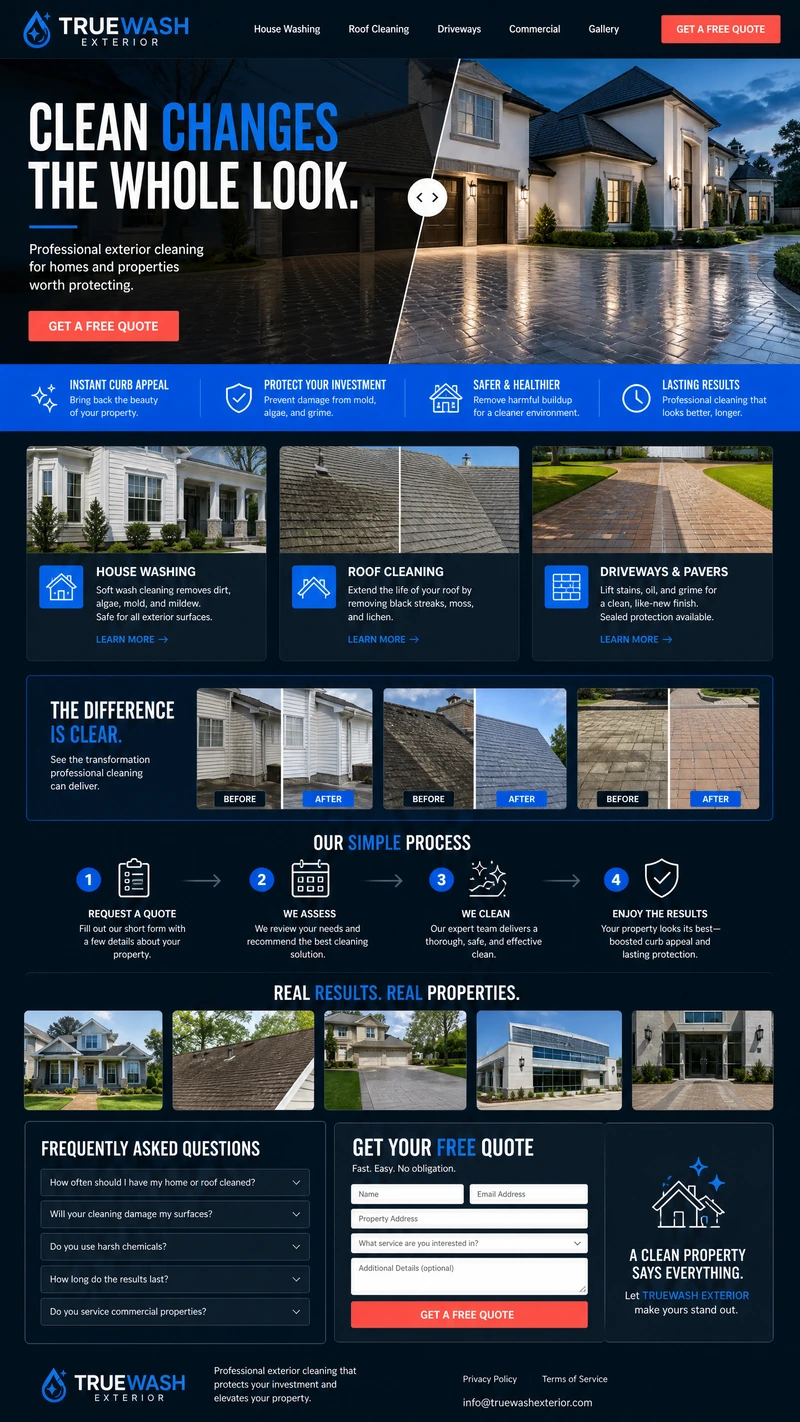



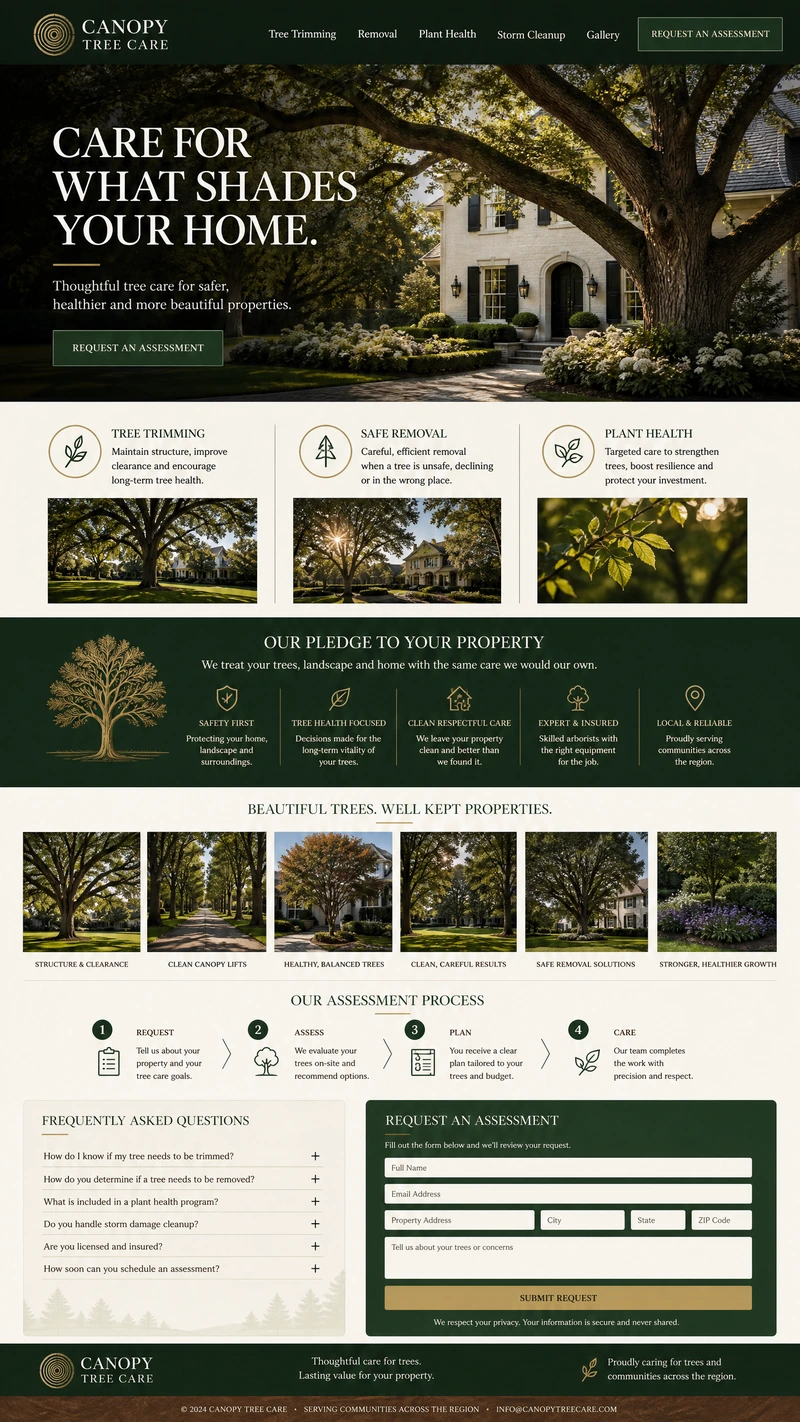


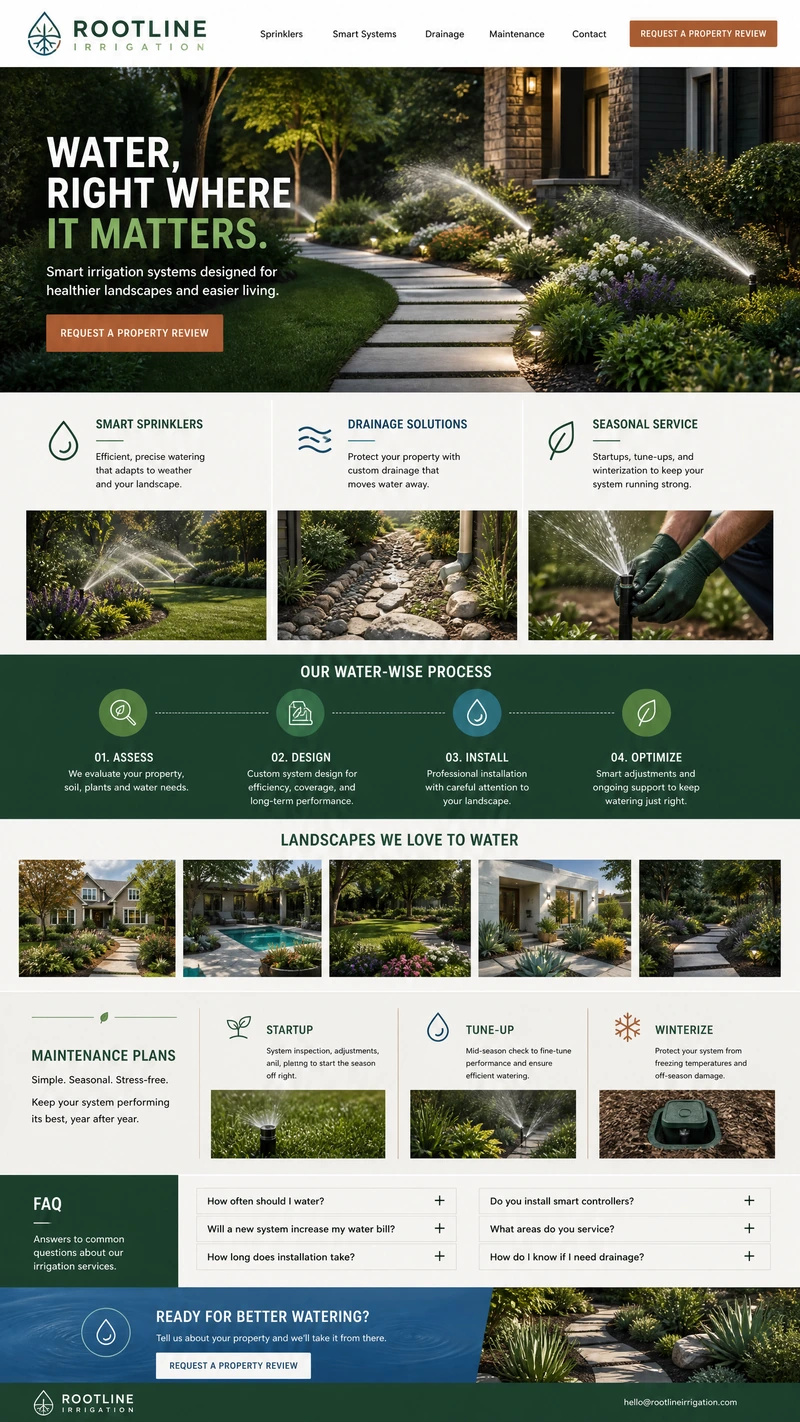

Design concepts produced in the studio, not client projects. Yours would be built for your business, from the same five directions.
It starts with finding out what is actually wrong, which is not always what somebody was told is wrong.
We begin with the business rather than the site: what you sell, what is worth most, where you work and who else is competing for the same searches. Then we look at what the site currently does, what search data already exists for it, and where the gap is between the two.
What comes out of that is a short list of the things worth doing in order, with the reasoning attached. Some of it is usually structural and one-off. Some of it is ongoing. We would rather tell you which is which than sell you a retainer for both.
Services, margins, service area, competition, and what a good month looks like.
The site's technical state, its structure, its content and whatever search data is already available.
A short ordered list, with the reason each item is on it and what it is expected to affect.
Technical fixes, structure, pages and content, in the order agreed.
Against search data rather than against a feeling. What moved, what did not, what to do next.
SEO builds visibility that compounds and takes time. Advertising buys visibility that starts immediately and stops when you stop. The website is where both of them land.
Treating them as competing budgets is the usual mistake. They answer different questions: advertising can tell you within a fortnight which messages and which searches produce enquiries, and that is information SEO would take months to gather. Equally, an SEO position keeps working on a month when nothing is spent.
Running them together is not about doing more. It is that each one makes the other cheaper to get right, and that both depend on the same website being clear about what you do.
Explains the business and turns attention into contact. Everything else sends people here.
Earns visibility for the searches your customers actually make. Slower to arrive, and it does not switch off.
Buys visibility now, on searches you choose, with a measurable path from click to enquiry.
SEO is measurable, and it is worth being precise about what the measurements are and are not.
Search data shows which queries a site appears for, how often, how far up, and how many people clicked. That is real information about visibility and it arrives whether or not anybody has set up anything clever. It tells you what is being found and for what.
What it does not tell you is what happened next. Whether a visit became a phone call is a question for analytics and conversion tracking, and it only gets answered if that tracking exists. Setting it up is usually part of the work, and where it does not exist we say so rather than reporting on traffic as though it were revenue.
No ranking, traffic or enquiry number is promised here, because none of them is ours to promise. What is promised is that you will be able to see what happened and be told what we think it means.
Months rather than weeks, and the honest answer is that it depends on the site, the competition and where you are starting.
Technical fixes can change how a site is crawled almost immediately. Earning a position for a competitive service phrase is slower. Anybody quoting you a specific ranking by a specific date is guessing.
No, and nobody can. Rankings are decided by a system neither of us controls, against competitors who are also working.
What we can commit to is the work, the reasoning behind it and reporting that shows what actually happened.
It is quoted per business, because the work varies enormously depending on what is already there.
A site with sound structure that needs content is a different project from one that needs rebuilding before anything can rank. We look first and quote after.
Not always. Plenty of sites can be improved without being replaced.
The cases where a rebuild is the cheaper route are when the structure cannot carry the services you sell, or the platform makes basic changes hard. We will tell you which one you are in.
Neither is better. They do different jobs on different timescales.
Advertising produces visibility and information quickly and stops when spending stops. SEO takes longer and keeps working. Most small businesses benefit from a clear answer about which one to start with, and that depends on how soon you need enquiries.
Yes. We are based in Florida and work with small businesses across the United States.
Search work does not require anybody to be in the room, and the service area that matters is yours rather than ours.
The site, the services that matter most and the area you work in. We will come back with what we think is worth doing first.