Local SEO
Restaurant Local SEO: A Practical Guide for Owners
Restaurant local SEO is the work that puts your restaurant in front of people searching nearby: a complete Google Business Profile, a website with a real menu, hours and address that match everywhere, and a steady flow of reviews you answer. None of it is complicated. Most of it is keeping details accurate week after week.
What Local Search Looks Like for a Restaurant
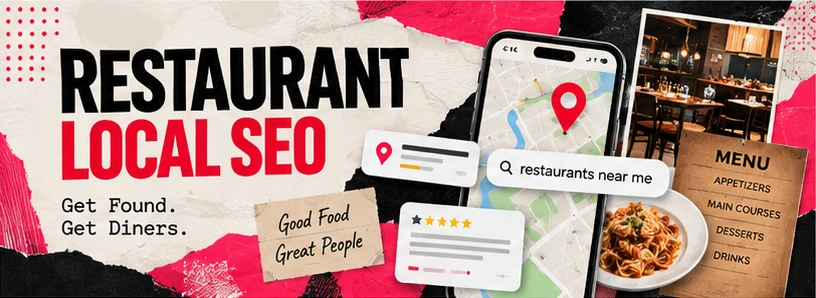
When someone searches for food nearby, the first thing they usually see is a map with a short list of places under it. Getting into that list is what local restaurant SEO is mostly about.
Searches like "tacos near me", "brunch in Oak Park" or "Thai restaurant open now" produce a map, three or so listings with photos and star ratings, and then ordinary web results. A guest can call, get directions, look at the menu or book a table without ever opening your website. That is why the profile matters as much as the site.
Google says local results are decided mainly by three things: relevance (how well your listing matches the search), distance (how far you are from the person or the place they named) and prominence (how well known you are, which includes reviews and what the web says about you). You cannot move your restaurant closer to anyone, so the work goes into the other two.
- Relevance: categories, menu items, descriptions and attributes that match what people search
- Prominence: reviews, photos, mentions on other sites and a website search engines can read
- Accuracy: hours, address and phone number that match everywhere, so nobody is sent to a closed door
Google Business Profile: The Fields That Matter
Fill in every field that applies to you, then keep the ones that change, like hours and the menu, current. A half-finished profile gives search engines less to match and guests less reason to choose you.
| Field | Why it matters | Common mistake |
|---|---|---|
| Primary category | The strongest signal of what you are | Choosing "Restaurant" when "Italian restaurant" or "Ramen restaurant" fits |
| Secondary categories | Lets you match more searches honestly | Adding categories you do not actually serve |
| Hours and special hours | Decides whether you show for "open now" | Forgetting holidays and private events |
| Menu link or menu items | Lets the listing match dish searches | Linking a PDF that is two seasons old |
| Order and reservation links | Gives guests a one-tap next step | Leaving a link to a service you no longer use |
| Attributes | Outdoor seating, delivery, accessibility and similar | Leaving them blank |
| Photos | Guests judge food and atmosphere from them | Only stock-looking shots, nothing recent |
| Description | Plain words about what you serve and your style | Stuffing it with city names and keywords |
Answer the questions people post on your profile, too. An unanswered question about parking or gluten-free options stays visible to everyone who looks.
Menu, Hours and Location Pages on Your Own Site
Your website is where search engines confirm what your profile says, and it is the one listing you fully control. It needs a menu written as text, your hours and a clear location page.
A menu search engines can read
A menu published as an HTML page, with dish names and short descriptions in text, can be matched to searches for those dishes. A PDF or a photo of a printed menu is much harder for a search engine to use, and it is miserable to read on a phone. Keep the PDF as a download if guests like printing it, but make the text page the main one.
One page per location
If you have more than one location, give each its own page with its address, hours, phone number, parking notes and map. Link each Business Profile to its own location page rather than to the home page.
Hours in plain text
Put your hours on the site as text, not inside an image, and update them at the same time you update your profile. A guest who sees different hours in two places trusts neither.
Reviews: Asking, Answering and What Not to Do
Ask every happy guest, answer every review, and never buy, fake or filter them. Reviews feed both your prominence in search and a guest's decision to walk in.
The simplest way to get more reviews is to ask at the right moment. A short line on the receipt, a card with a QR code that opens your review link, or a follow-up email after an online order all work without being pushy. Staff mentioning it to a table that clearly enjoyed the meal is the most natural of all.
Answer reviews as the owner, not as a template. Thank people specifically, and reply to complaints calmly with what you did or will do about it. Future guests read the replies as much as the reviews.
- Do share your direct review link in places guests already see
- Do reply to negative reviews within a few days, briefly and without arguing
- Do not offer discounts or freebies in exchange for reviews; Google's policies prohibit incentives
- Do not ask only the guests you expect to be happy; selective asking is against the same policies
- Do not write reviews for yourself or have staff and family do it
Citations and Consistency Across Listings
A citation is any place your restaurant's name, address and phone number appear online. They should match each other exactly, because conflicting details make search engines less sure which ones are right.
Check these listings first
- Google Business Profile
- Apple Maps (through Apple Business Connect)
- Bing Places
- Yelp and the review sites popular in your area
- Every delivery and reservation platform you are listed on
- Your local chamber of commerce or tourism site, if you are listed
Make sure each one has
- The same restaurant name, without added keywords
- The same street address format, including suite numbers
- The same phone number, ideally one that rings at the restaurant
- Current hours and a link to your own website
When you move, change your phone number or rebrand, update every listing in the same week. Old details left on a forgotten platform are a common source of wrong information.
What to Measure Each Month
Set aside half an hour a month to look at the same few numbers and fix whatever drifted. Local SEO for a restaurant rewards consistency more than big projects.
- Open your Google Business Profile performance view and note calls, direction requests and website clicks against last month.
- Read every new review and reply to any you missed.
- Check that hours, holiday hours and the menu link on the profile are still correct.
- Add a handful of new photos: a new dish, the room on a busy night, the patio when it opens.
- Search for your main dishes and your neighborhood from your phone and see where you appear.
- Confirm the website still loads quickly on a phone and the menu page matches what you serve.
Search results change from day to day and from one street to the next, so a single search is a snapshot. Look for the trend over several months, not one result.
Frequently asked questions
Do I need a website if I have a Google Business Profile?
Yes. The profile is where many guests find you, but your website is the only listing you control completely, and search engines use it to confirm what the profile says.
A site also gives you a proper menu page, location pages and a place to send people from social media, email and ads.
How long does local SEO take for a restaurant?
There is no fixed timeline. Fixing wrong hours or a missing category can change what people see quickly, while building reviews and mentions takes months of steady work.
Anyone who promises a specific position by a specific date is guessing.
Should my menu be a PDF?
Not as the main version. Publish the menu as a text page on your site and offer the PDF as an optional download.
Text can be read by search engines and resizes properly on a phone; a PDF does neither well.
Do delivery app listings help my local SEO?
They are citations, so keep them accurate, but they do not replace your own profile and website.
Make sure the name, address and phone number on each app match your other listings, and link to your own site wherever the platform allows it.
Need a restaurant site built for local search?
We build restaurant websites with a real menu page, location details that match your profile and links to the ordering and reservation services you already use.